
Inhibition or Enhancement?
Autophagy and Cancer Chemotherapy
Inhibition or Enhancement?
Janice M Santiago-O’Farrill, Zhen Lu and Robert C Bast Jr
A
utophagy is a cellular degradative mechanism whereby long-lived proteins and damaged organelles are sequestered within intracytoplasmic double walled autophagosomes that fuse with lysosomes where proteins and lipids are hydrolyzed into amino and fatty acids that can provide energy in nutrient poor conditions [3]. The importance of this cellular process has been established in different physiological and pathological conditions such as aging, neurodegenerative diseases and cancer [4-6]. In cancer in particular, several studies have reported autophagy to exert a dual role, either functioning as a pro-survival cell mechanism or as a pro-death mechanism for cancer cells [7]. Many anti-cancer therapies such as DNA damaging agents, radiation therapy and targeted therapies can induce autophagy in cancer cells [8-10]. Recent studies have found that inhibition of chemotherapy-induced autophagy can enhance the sensitivity of cancer cells to different chemotherapies, leading to cell death and tumor regression [8,11,12]. Based on these observations, cytoprotective autophagy has received considerable attention because of its potential clinical relevance in modulating drug resistance. In contrast, autophagy also has a complex and incompletely understood role as a cell death inducing mechanism. Given this paradox, the role of autophagy in cancer remains unclear and is likely to be contextual, varying with different agents and tumor types. Understanding the mechanisms that underlie these two different effects of autophagy on cancer cells could aid in developing more effective therapies.
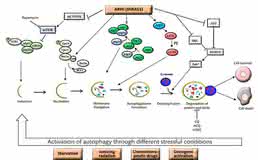
Over the last decade, our group has extensively studied Aplasia Ras homolog member I (ARHI; DIRAS3), a maternally imprinted gene, which encodes a 26 kD GTPase with 50% homology to Ras, but with an opposite function [13]. ARHI is downregulated in 60% of ovarian cancers associated with decreased disease-free survival [13]. Upregulation of ARHI at physiologic levels inhibits cancer cell growth, reduces motility and invasion, induces autophagy and establishes dormancy [13,14]. A human xenograft model has been developed that permits doxycycline-inducible expression of ARHI leading to tumor dormancy where survival of ovarian cancer cells depends upon autophagy. Recent studies point to the clinical relevance of this model where more than 80% of cases of dormant, drug resistant ovarian cancer found on the peritoneal surface at “second look” operations after primary surgery and chemotherapy express high levels of ARHI and are undergoing autophagy [15]. The article “ARHI (DIRAS3)- mediated autophagy-associated cell death enhances chemosensitivity to cisplatin in ovarian cancer cell lines and xenografts”, by Washington et al. is of considerable interest, as it provides new insight into the autophagic paradox and brings together several of the elements that are relevant for the study of this process [15]. In this article, our group explored mechanisms by which ARHI induces autophagic cell death and enhances cisplatin cytotoxicity. We confirmed that cell proliferation, autophagy and tumor dormancy can be regulated by ARHI. In cell culture, ARHI-induced autophagy led to increased cisplatin cytotoxicity and cell death, accompanied by induction of ROS, activation of caspase 3, PARP cleavage and downregulation of the anti-apoptotic proteins BCL2 and XIAP. In cell culture, treatment with the autophagy inhibitor, chloroquine (CQ), decreased the cisplatin induced cytotoxicity. In xenografts, cisplatin treatment significantly slowed the outgrowth of dormant autophagic cells after reduction of ARHI. However, the addition of CQ to cisplatin did not further delay outgrowth of dormant cancer cells [15]. This study suggests that ARHI can induce autophagy-associated cell death in culture, but that this may not be observed in vivo (Figure 1).
Autophagy inhibitors show a wide range of sensitization; in some therapeutic settings or tumor models these inhibitors have only minimal to modest effects but in other cases these inhibitors are significantly effective[16]. Although hydroxychloroquine (HCQ), a derivative of CQ, is currently being evaluated in clinical trials that combine chemotherapeutic agents with HCQ, a major concern is that that the high concentrations of HCQ that are required to block autophagy in cell culture may be difficult to achieve and maintain in patients [7,17]. The cytotoxic effects of CQ and HCQ on cancer cell death have been attributed to inhibition of autophagy. Recent studies, however, have described different mechanisms by which CQ induces cell death including promotion of cell cycle arrest, activation of ataxia telangiectasia mutated (ATM), upregulation of TP53 and induction of apoptosis [18-20]. New studies are underway to develop more potent autophagy inhibitors [17]. Amaravadi et al. have developed a new autophagy inhibitor, LYS05, with the potential to inhibit autophagy in vivo with single agent anti-tumor activity. Different derivatives of this agent are under investigation with the goal of identifying autophagy inhibitors with nanomolar activity [17] (Figure 2).
As mentioned above, autophagy not always has a cytoprotective role. Excessive levels of autophagy have the potential to induce cell death and some studies have shown that autophagy is necessary for the cytotoxic effect of the therapy that is being tested [10,21]. Therefore, autophagy inducers have also been considered as potential cancer treatments [22,23]. Several mTOR inhibitors with anti-tumor activity induce autophagy, including rapamycin and its analogs temsirolimus, everolimus, and deforolimus [12]. These agents, however, affect many cellular processes in addition to autophagy which may be responsible for their ant-tumor activity [12]. Our group also studied the contribution of the microenvironment in deciding the fate of autophagy. Different survival factors such as VEGF, IL-8 and IGFR found in the tumor microenvironment can rescue ovarian cancer cells undergoing ARHI-mediated autophagic cell death in culture [13]. Treatment with specific monoclonal antibodies against each of these survival factors prevent the outgrowth of autophagic cells, suggesting that these factors contribute to determine the fate of autophagic cells and that their inhibition could provide a novel strategy for eliminating dormant ovarian cancer cells [13]. The question of whether to inhibit or enhance autophagy to improve chemotherapeutic efficacv remains to be resolved in different tumor types and different clinical settings.
In conclusion, the role of autophagy in modulating cancer cell survival is still controversial. IdentificatioQ of biomarkers that delineate the role of autophagy in different malignancies is critical to distinguish which patients will benefit from autophagy inhibition as therapeutic approach. The insight gained from the study of Washington et al. demonstrates that autophagy can enhance the therapeutic activity of cisplatin, at least in cell culture. As ARHI is downregulated in breast, lung, prostate, pancreatic, hepatic and thyroid cancer, these observations may also apply autophagy and chemotherapy in other types of cancers.
References
1. Amaravadi RK (2008) Autophagy-induced tumor dormancy in ovarian cancer. J Clin Invest 118: 3837-3840.
2. Wang CW, Klionsky DJ (2003) The molecular mechanism of autophagy. Mol Med 9: 65-76.
<figure-space>3. Glick D, Barth S, Macleod KF (2010) Autophagy: cellular and molecular mechanisms. J Pathol 221: 3-12.
<figure-space>4. Mizushima N, Levine B, Cuervo AM, Klionsky DJ (2008) Autophagy fights disease through cellular self-digestion. Nature 451: 1069-1075.
<figure-space>5. Frake RA, Ricketts T, Menzies FM, Rubinsztein DC (2015) Autophagy and neurodegeneration. J Clin Invest 125: 65-74.
<figure-space>6. Rubinsztein DC, Mariño G, Kroemer G (2011) Autophagy and aging. Cell 146: 682-695.
<figure-space>7. Gewirtz DA (2014) The four faces of autophagy: implications for cancer therapy. Cancer Res 74: 647-651.
<figure-space>8. Amaravadi RK, Yu D, Lum JJ, Bui T, Christophorou MA, et al. (2007) Autophagy inhibition enhances therapy-induced apoptosis in a Mycinduced model of lymphoma. J Clin Invest 117: 326-336.
<figure-space>9. Gewirtz DA (2014) The autophagic response to radiation: relevance for radiation sensitization in cancer therapy. Radiat Res 182: 363-367.
10. Sharma K, Le N, Alotaibi M, Gewirtz DA (2014) Cytotoxic autophagy in cancer therapy. Int J Mol Sci 15: 10034-10051.
11. Guo XL, Li D, Hu F, Song JR, Zhang SS, et al. (2012) Targeting autophagy potentiates chemotherapy-induced apoptosis and proliferation inhibition in hepatocarcinoma cells. Cancer Lett 32: 171-179.
12. Yang ZJ, Chee CE, Huang S, Sinicrope FA (2011) The role of autophagy in cancer: therapeutic implications. Mol Cancer Ther 10: 1533-1541.
13. Lu Z, Luo RZ, Lu Y, Zhang X, Yu Q, et al. (2008) The tumor suppressor gene ARHI regulates autophagy and tumor dormancy in human ovarian cancer cells. J Clin Invest 118: 3917-3929.
14. Lu Z, Bast RC Jr (2013) The tumor suppressor gene ARHI (DIRAS3) inhibits ovarian cancer cell migration through multiple mechanisms. Cell Adh Migr 7: 232-236.
15. Washington MN, Suh G, Orozco AF, Sutton MN, Yang H, et al. (2015) ARHI (DIRAS3)-mediated autophagy-associated cell death enhances chemosensitivity to cisplatin in ovarian cancer cell lines and xenografts. Cell Death Dis 6: e1836.
16. Bristol ML, Emery SM, Maycotte P, ThorburQ A, Chakradeo S, et al. (2013) Autophagy inhibition for chemosensitization and radiosensitization in cancer: do the preclinical data support this therapeutic strategy? J Pharmacol Exp Ther 344: 544-552.
17. Amaravadi RK, Winkler JD (2012) Lys05: a new lysosomal autophagy inhibitor. Autophagy 8: 1383-1384.
18. Jiang PD, Zhao YL, Shi W, Deng XQ, Xie G, et al. (2008) Cell growth inhibition, G2/M cell cycle arrest, and apoptosis induced by chloroquine in human breast cancer cell line Bcap-37. Cell Physiol Biochem 22: 431-440.
19. Bakkenist CJ, Kastan MB (2003) DNA damage activates ATM through intermolecular autophosphorylation and dimer dissociation. Nature 421: 499-506.
20. Loehberg CR, ThompsoQ T, Kastan MB, Maclean KH, Edwards DG, et al. (2007) Ataxia telangiectasia-mutated and p53 are potential mediators of chloroquine-induced resistance to mammary carcinogenesis. Cancer Res. 67: 12026-12033.
21. Yan CH, Yang YP, Qin ZH, Gu ZL, Reid P, et al. (2007) Autophagy is involved in cytotoxic effects of crotoxin in human breast cancer cell line MCF-7 cells. Acta Pharmacol Sin 28: 540-548.
22. Levine B, Packer M, Codogno P (2015) Development of autophagy inducers in clinical medicine. J Clin Invest 125: 14-24.
23. Kim YC, Guan KL (2015) mTOR: a pharmacologic target for autophagy regulation. J Clin Invest 125: 25-32.
© 2016 Santiago-O’Farrill JM, et al. This is an open-access article distributed under the terms of the Creative Commons Attribution License, which permits unrestricted use, distribution, and reproduction in any medium, provided the original author and source are credited. Citation: Santiago-O’Farrill JM, Lu Z, Bast RC (2016) Autophagy and Cancer Chemotherapy: Inhibition or Enhancement?. Single Cell Biol 5: 145. doi:10.4172/2168-9431.1000145
Janice M Santiago-O’Farrill
Zhen Lu
Robert C Bast Jr
Department of Experimental Therapeutics
University of Texas
MD Anderson Cancer Center
Houston, Texas, USA
Corresponding authors
Robert C Bast Jr and Zhen Lu


Das könnte Sie auch interessieren
Neue mechanische Einblicke in Tumorzellen
Zellviskosität als Schlüsselfaktor der Metastasierung
Studie zeigt, dass die Viskosität von Tumorzellen entscheidend für Zirkulation, Extravasation und Metastasenbildung ist. Mechanische Eigenschaften beeinflussen den Fortschritt von Krebszellen im Blutkreislauf.
 mehr...
Paul Ehrlich- und Ludwig Darmstaedter-Nachwuchspreis 2026 für Varun Venkataramani
Dr. Dr. Varun Venkataramani wird für seine Forschung zu Glioblastomen mit dem Ludwig Darmstaedter-Nachwuchspreis 2026 ausgezeichnet. Er hat das Forschungsgebiet "Cancer Neuroscience" mitbegründet und zeigt, wie Krebszellen das Stromnetz der Nerven...
mehr...Walter-Krienitz-Doktoranden-Preis für Thilo...
Magenkrebs gezielter behandeln: Wann Chemotherapie nicht wirkt
Neue Forschung aus Magdeburg zeigt: Patienten mit MMR-defektem Magenkrebs profitieren oft nicht von Standard-Chemotherapie. Alternativen wie Immuntherapie könnten gezielter wirken und Nebenwirkungen vermeiden.
mehr...Förderprogramm der Deutschen Krebshilfe
Deutsche Krebshilfe fördert fünf onkologische Versorgungsnetzwerke für bessere Patientenversorgung
Die Deutsche Krebshilfe fördert fünf regionale Netzwerke zwischen Kliniken und Krebszentren. Sie unterstützt den Aufbau der regionalen Behandlungsnetzwerken mit zwölf Millionen Euro. Ziel ist eine flächendeckend vernetzte, wohnortnahe und qualitativ...
mehr...Neue Erkenntnisse aus der Forschung zu Eierstockkrebs
Forschende zeigen mithilfe einer Kombination der Deep Visual Proteomics-Technologie mit der räumlichen Transkriptomik, wie gutartige Eierstocktumoren zu invasivem und metastasierendem Krebs fortschreiten.
mehr...Chancen und Herausforderungen beim Nachweis zellfreier Tumor-DNA im diagnostischen Alltag
Liquid Biopsy ermöglicht die Analyse von Tumorerkrankungen anhand zirkulierender Tumor-DNA im Blut – ohne invasive Eingriffe. Der Beitrag gibt einen Überblick über klinische Einsatzmöglichkeiten, technische Anforderungen und qualitätssichernde...
mehr...Digitale PCR
Roche hat das "Digital LightCycler"-System auf den Markt gebracht, das für Labore konzipiert wurde, die präzise DNA- und RNA-Analysen in Bereichen wie Onkologie und Infektionskrankheiten durchführen möchten.
mehr...DKMS Stiftung Leben Spenden fördert junge Wissenschaftler
Zum Internationalen Tag der Wissenschaft am 10. November lädt die DKMS Nachwuchswissenschaftler dazu ein, sich um die begehrten John Hansen Research Grants – die vier Stipendien der DKMS Stiftung Leben Spenden – zu bewerben.
mehr...Signalmolekül löst tumorspezifische...
Zelluläre Antwort auf Wnt kann Krankheitsverlauf bei Darmkrebs anzeigen
Signalmoleküle der Wnt-Familie gelten als wichtige Biomarker und therapeutischer Angriffspunkt bei Darmkrebs. Welche zelluläre Antwort durch Wnt ausgelöst wird, kann einen günstigen oder schlechten Krankheitsverlauf bei Darmkrebspatienten anzeigen.
mehr...