
Genomics/ProteomicsAccuracy of Next Generation Sequencing Platforms
Next-generation DNA sequencing has revolutionized genomic studies and is driving the implementation of precision diagnostics. The ability of these technologies to disentangle sequence heterogeneity, however, is limited by their relatively high error rates.
Seite [2 von 3]
 | | | Bild 2 von 3 | | | |
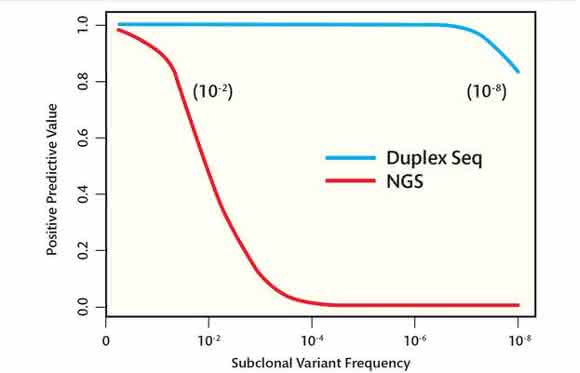
Figure 1: Comparison of the probability that an observed variant is real [54] for subclonal variants using Q30-filtered reads of an Illumina HiSeq2500 (NGS) versus Duplex Sequencing. Error Frequencies of each approach is given in parenthesis. PPV (Positive Predictive Value)=(Expected Number of true positives)/(Expected Total Number of Positive Calls). Note that the PPV is 0.50 for NGS when the variant frequency at a single position is ~1/100, i.e., any variant call has a 50/50 chance of being real hen the frequency of real variants equals the frequency of mistakes invalidity [62].