
Zell- und MikrobiologieInsights into the Molecular Antiviral Mechanism of Pokeweed Protein from Phytolacca americana
Agriculture is an indispensable part of every person’s life, ensuring that nutritious and inexpensive food is readily available. As any other organisms, plants are subject to numerous parasitic infections.
Seite [2 von 2]
 | | | Bild 2 von 2 | | | |
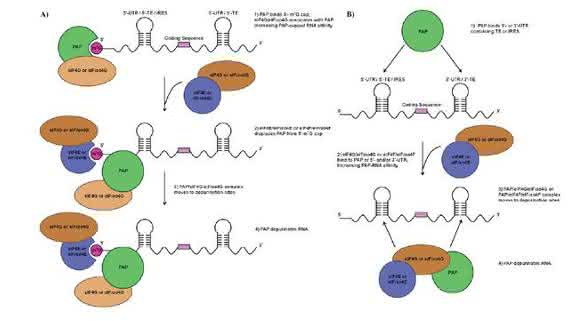
Figure 1: Schematic diagram of the proposed model for PAP interaction with initiation factors and capped (A) or uncapped (B) RNA. A) Step 1: PAP binds to 5’-m7G cap; eIF4G/eIFiso4G associates with PAP; eIF binding increases PAP-RNA affinity; Step 2: eIF4E/eIFiso4E or eIF4F/eIFiso4F displaces PAP from 5’-m7G cap; Step 3: PAP/eIF4G/eIFiso4G complex translocates to depurination sites; Step 4: PAP depurinates RNA. B) Step 1: PAP binds 5’- or 3’-UTRs (untranslated regions) containing TEs (translational enhancer sequences), or IRES (internal ribosome entry site); Step 2: eIF4G/eIFiso4G or eIF4F/eIFiso4F bind to PAP or 5’- and/or 3’-UTRs, increasing PAP-RNA affinity; Step 3: PAP/eIF4G/eIFiso4G or PAP/eIF4F/eIFiso4F complex translocates to depurination sites; Step 4: PAP depurinates RNA.