
Combining Disparate Data TypesProtein Sequences and Protein Structures
There are many opportunities from combining disparate types of data. The example below is the investigation of protein variability and evolution by combining protein structures with sequences.
Seite [2 von 4]
 | | | Bild 2 von 4 | | | |
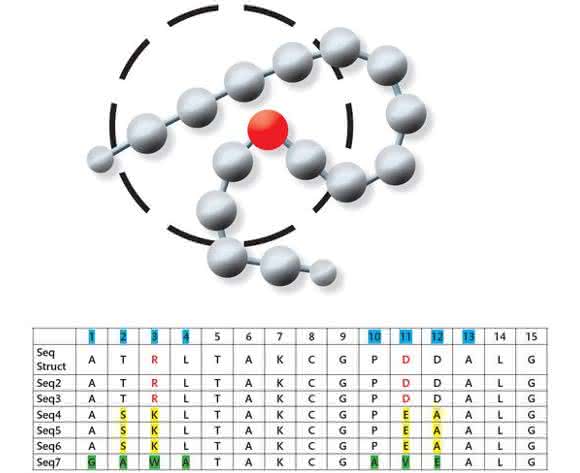
Figure 1: Including additional clusters based on sequence alignments. A physical cluster of 8 close residues (residues 1-4 and 10-13 identified in blue in the table headings) is shown within the dashed circle at the top, with the central one in red. Sequence alignments show variations at the positions shown in highlights. We will use these additional sequences from the reliable multiple sequence alignments to include additional clusters with these specific sequence changes. The changed sequences in the additional clusters will significantly enhance the present studies by providing a large increase in the number of clusters of interacting residues that available for this project, far beyond the number taken directly from experimental structures [modified from [4]].