
Proteome Dynamics of the SpecialistOxalate Degrader Oxalobacter formigenes
Oxalobacter formigenes is a unique intestinal organism that relies on oxalate degradation to meet most of its energy and carbon needs. A lack of colonization is a risk factor for calcium oxalate kidney stone disease.
Seite [3 von 3]
 | | | Bild 3 von 3 | | | |
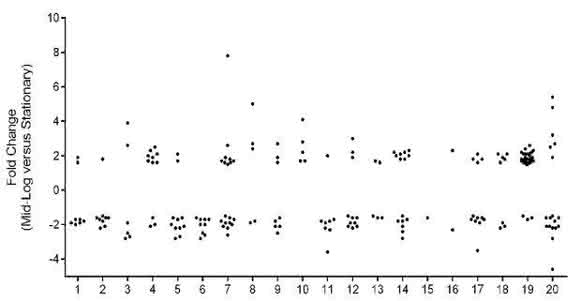
Figure 2: Fold change in protein levels of O. formigenes cells from log to stationary phase, as categorized by functional category. Functional categories: 1, Amino acid transport and metabolism; 2, Carbohydrate transport and metabolism; 3, Cell cycle control, cell division, chromosome partitioning; 4, Cell wall/membrane/envelope biogenesis; 5, Coenzyme transport and metabolism; 6, Defense mechanisms; 7, Energy production and conversion; 8, General function prediction only; 9, Inorganic ion transport and metabolism; 10, Intracellular trafficking, secretion, and vesicular transport; 11, Lipid transport and metabolism; 12, Nucleotide transport and metabolism; 13, Posttranslational modification, protein turnover, chaperones; 14, Replication, recombination and repair; 15, RNA processing and modification; 16, Secondary metabolites biosynthesis, transport and catabolism; 17, Signal transduction mechanisms; 18, Transcription; 19, Translation, ribosomal structure and biogenesis; 20, Unknown.