
EAEC Under StressLoss of Biofilm Formation
Enteroaggregative Escherichia coli is an emerging foodborne pathogen as a significant diarrheal pathogen in multiple population groups. However, the associated phenotypic changes by which EAEC bacteria survive acid conditions, is not completely understood.
Seite [6 von 6]
 | | | Bild 6 von 6 | | | |
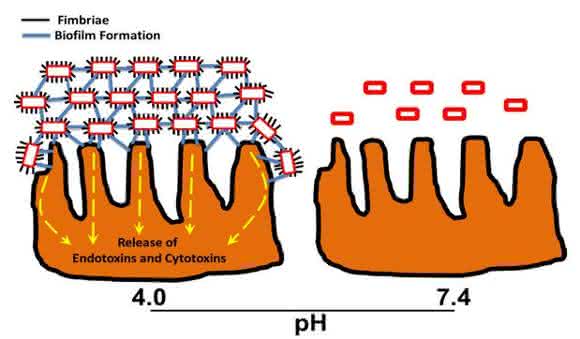
Figure 3: Schematic presentation of loss of phenotypic characters in EAEC (T8) under acid stress. EAEC (T8) demonstrated media-dependent growth rate. The reduction in cell survival of EAEC (T8) grown in vitro with HEp-2 cells at pH 4.0 could be due to decreased proliferation or increased cell death. EAEC (T8) demonstrated changes in its phenotypic characters including lack of the clump formation and hemagglutination during acid stress (pH 4.0). The biofilm formation at pH 4.0 was negligible, which is a deviation from the three-stage model proposed for EAEC pathogenesis. The lack of typical aggregative adherence pattern at pH 4.0 of EAEC (T8) might be related with the changes in cell morphology.